
The Human Capability Project
You Knew How to Handle the Conversation. So What Happened?
You’ve had the conversation before.
You knew how to listen.
You knew what questions to ask.
You knew not to become attached to the outcome.
But something changed.
You started thinking about what you were going to say instead of hearing what the other person was telling you.
You missed the hesitation that seemed obvious afterward.
You interpreted uncertainty as rejection.
You pushed when you normally would have remained curious.
Or you allowed one difficult conversation to affect the next three.
Your knowledge didn’t disappear.
Your sales skills didn’t disappear.
Something changed in your ability to access them.
Because sales doesn’t only test what you know.
It tests what you can consistently access while the conversation is unfolding, the outcome matters, and your emotional state is changing.
And that raises an important question:
What influences how consistently you can access the capabilities you already possess—especially when the outcome matters?
That question is at the heart of the Human Capability Project.

What Does That Actually Mean?
For years, I’ve been exploring a much bigger question:
What are human beings actually capable of?
My exploration began many years ago with Neuro-Linguistic Programming.
From there, it expanded through a number of different lenses:
Law of Attraction.
Meditation.
Spirituality.
Energy work.
Consciousness.
Different approaches.
Different language.
Different explanations for what may be happening.
But underneath all of them was the same fascination:
There seemed to be far more going on within us than most of us ever stop to consider.
Over time, that exploration led me to a simple statement that became the foundation of my work:
You Are Powerful Beyond Measure.
Eventually, that statement raised another question:
How are we powerful beyond measure?
Over time, I came to realize that the answer was much more practical than I had originally imagined.
It’s because of the remarkable innate capabilities we possess simply as part of being human.
Consider how many of those capabilities you rely on during a sales conversation.
Attention and focus — staying present with the person in front of you instead of becoming distracted by what you want to say next or how you want the conversation to end.
Listening — hearing not only the words being spoken, but what may be underneath them.
Pattern recognition — noticing connections, recurring themes, changes in language, and details that may not be immediately obvious.
Communication — expressing yourself clearly while accurately understanding what someone else is communicating.
Empathy — recognizing what another person may be experiencing and seeing the situation from their perspective.
Discernment — recognizing what matters, what doesn’t, and where the conversation may need to go next.
Intuition — sensing when something deserves another question, even when you may not consciously understand why.
Problem-solving — recognizing possibilities and helping someone find their way through a challenge.
Creativity — generating new ideas, perspectives, and solutions when the familiar approach doesn’t fit.
Adaptability — adjusting when the conversation changes direction or something unexpected emerges.
Emotional regulation — remaining present when you hear no, encounter resistance, or feel pressure around the outcome.
Confidence — trusting your experience and capabilities enough to respond naturally rather than reaching for the “right” sales response.
And your brain possesses neuroplasticity — the ability to change through experience and repetition.
Think about how much of a sales conversation depends upon access to those capabilities.
How closely you listen.
What you notice.
The questions you ask.
How clearly you interpret what someone is telling you.
Whether you recognize a pattern.
Whether you sense hesitation, curiosity, uncertainty, or genuine interest.
How naturally you respond when the conversation changes direction.
How well you recover when you hear no.
How clearly you think when the outcome matters.
And how the other person experiences you throughout the conversation.
Your product knowledge matters.
Your sales training matters.
Your preparation matters.
Your experience matters.
But ultimately, all of it has to be expressed through you while the conversation is actually happening.
That’s when You Are Powerful Beyond Measure stops sounding like an inspirational statement.
It starts looking more like an observation.
If You Already Possess All of These Capabilities…
Why are they easier to access during some conversations than others?
Why can you listen deeply during one conversation…
And find yourself thinking about what you’re going to say next during another?
Why can you immediately recognize what someone really needs sometimes…
Yet completely miss something that seems obvious afterward?
Why can your intuition feel clear in one conversation…
Then become buried beneath doubt in another?
Why can you communicate naturally and confidently one moment…
Then start searching for the right words when you become attached to the outcome?
Why can rejection roll off you one day…
And affect the next three conversations on another?
Your knowledge didn’t disappear.
Your experience didn’t disappear.
Your sales skills didn’t disappear.
Your access changed.
And that access can be influenced by a lot of things:
Stress.
Sleep.
Fatigue.
Emotional state.
Expectations.
Pressure.
Nutrition.
Movement.
Your environment.
Your nervous system.
Your attachment to the outcome.
And the patterns you’ve repeatedly practiced.
That’s why two versions of you can sometimes feel completely different even though the same salesperson is still there.
There are days when conversations simply seem to flow.
You’re confident.
Present.
Curious.
You listen more closely.
You ask better questions.
You notice things you might otherwise miss.
You respond naturally instead of searching for the right thing to say.
Connection feels easier.
And the conversation seems to go where it needs to go.
Then there are other days.
Same knowledge.
Same skills.
Same experience.
But somehow, you’re not bringing quite the same version of yourself into the conversation.
Maybe something frustrated you earlier.
Maybe the last conversation didn’t go particularly well.
Maybe you’re distracted by something happening outside of work.
Maybe you’re feeling pressure to produce a particular result.
Maybe you’re tired.
Or maybe you’re simply feeling off.
Whatever the reason, something changed.
And when your state changes, what you can easily access can change with it.
Your focus.
Your confidence.
Your patience.
Your creativity.
Your discernment.
Your ability to listen.
Your ability to recognize what matters.
Your ability to adapt.
Your ability to connect.
Your ability to trust what you already know.
That raises a much more useful question than:
“What’s wrong with me today?”
The better question may be:
“What is influencing my access right now?”
Because once you begin thinking in terms of access, you can start exploring something much more practical:
How can I create conditions that make more of what I’m already capable of consistently available when the conversation—and the outcome—matter?

Getting Out in Front of It
Most sales training begins at the level of thought and behavior.
What should you say?
What questions should you ask?
How should you handle an objection?
How should you follow up?
How should you redirect an unproductive thought?
How should you respond when the conversation doesn’t go the way you expected?
All of that can be valuable.
But there’s another question worth considering:
What internal state are those thoughts and behaviors coming from?
Think about how differently you listen, interpret, communicate, and respond when you feel calm, confident, curious, and connected…
Compared with when you feel frustrated, pressured, distracted, uncertain, or overly attached to the outcome.
Same training.
Same knowledge.
Same conversation.
Different state.
Different access.
Most of us wait until something disrupts our state before trying to change it.
A frustrating email.
A prospect who doesn’t respond.
A difficult conversation.
An unexpected objection.
A rejection.
Pressure around a goal.
Something happening at home.
And before long, we may be carrying the emotional residue of one experience into the next conversation.
Then we try to recover in the moment.
But what if you worked one layer earlier?
What if you intentionally supported the conditions influencing your access before the first conversation ever began?
You already prepare in other ways.
You learn your product.
You develop your skills.
You research your customers.
You prepare for important meetings.
You practice what you’re going to say.
But what about preparing the person who has to bring all of that into the conversation?
Getting out in front of it means looking at the whole system.
Your emotional state.
Your nervous system.
Your sleep.
Your nutrition.
Your digestion.
Your movement.
Your recovery.
Your expectations.
And the emotional patterns you repeatedly practice.
All of these can influence what feels available to you at any particular moment.
Same capabilities.
Different conditions.
Different access.
So getting out in front of it means supporting both sides of the equation:
The emotional conditions influencing how you listen, interpret, communicate, connect, and respond.
And the biological conditions supporting the brain and body through which all of those capabilities must be expressed.
We’re going to explore both.
First, we’ll look at the emotional side—and how intentional practice can help make certain states more familiar and more available throughout your day.
Then we’ll explore ways to support the biological foundation underneath the person having every one of those conversations.
Because more consistent performance isn’t only about knowing what to do when the moment arrives.
It’s also about creating more supportive conditions before you need to do it.
Intentional Emotional Rehearsal
You already understand that repetition matters.
It’s how you develop sales skills.
Learn your product.
Improve your communication.
Become more comfortable asking questions.
Recognize patterns.
Respond to objections.
And become better at navigating conversations.
But repetition doesn’t only shape what you know or what you can do.
It can also shape the emotional states and responses that become familiar to you.
Think about how often someone in sales may unintentionally rehearse:
Frustration when someone doesn’t respond.
Anxiety about reaching a goal.
Disappointment after hearing no.
Pressure before an important presentation.
Self-doubt after a difficult conversation.
Impatience when results aren’t coming quickly enough.
Or worry about where the next sale will come from.
You are rehearsing emotions all the time.
The only question is:
Are you doing it by design or by default?
The more often an emotional response is repeated, the more familiar that pattern can become.
And the more familiar it becomes, the easier it may be to return to when something similar happens again.
But the same principle can be used intentionally.
What if you deliberately practiced greater access to states like:
Love.
Appreciation.
Abundance.
Joy.
Calm.
Clarity.
Focus.
Confidence.
Emotional stability.
Not because you expect to feel that way during every conversation.
And not because frustration, disappointment, pressure, or uncertainty are somehow wrong.
But because those are valuable internal states to have more consistently available when the demands of selling begin pulling you somewhere else.
We refer to this as Intentional Emotional Rehearsal.
Instead of waiting until you feel pressured to look for calm…
Or distracted to look for focus…
Or discouraged to look for confidence…
Or attached to the outcome to look for clarity…
You practice greater access to those states before you need them.
You establish emotional momentum in the direction you want to go before the calls, emails, meetings, expectations, and outcomes of the day begin establishing it for you.
And over time, there may be an even larger opportunity.
The emotional states you experience and rehearse repeatedly can help shape the baseline you tend to return to.
Your emotional baseline isn’t one emotion you feel every minute of the day.
It’s the range of emotional states that has become most familiar to your system through repetition.
If worry, frustration, pressure, and disappointment are the states you rehearse most consistently, they may become easier to return to when something happens.
But the same process can work in the opposite direction.
The more consistently you rehearse calm, clarity, confidence, appreciation, and emotional stability, the more familiar those states may become.
More available.
And easier to return to.
That doesn’t mean you’ll never become frustrated.
It doesn’t mean rejection will never affect you.
And it doesn’t mean every conversation will go the way you want.
It means you’ve spent time practicing another place to return to.
So when something disrupts your state, you may recognize it sooner, interrupt the momentum more quickly, and find your way back before one difficult moment becomes the emotional starting point for everything that follows.
The goal isn’t to eliminate every difficult emotional response.
It’s to become more practiced at accessing—and returning to—the states that help you listen, interpret, communicate, connect, and respond the way you want.
Because your emotional state doesn’t only influence what you say.
It can influence what you hear.
What you notice.
How you interpret hesitation.
Which questions occur to you.
Whether you remain curious.
How naturally you respond.
And how the other person experiences you.
The capabilities are already there.
You’re not practicing the capability.
You’re practicing the state from which greater access to that capability may become possible.
Later on this page, you’ll have an opportunity to experience what this type of practice can feel like for yourself.
But emotional conditioning is only one side of the equation.
Because every thought, feeling, interpretation, decision, and response is being expressed through a living biological system.
So before we return to the emotional practice, let’s look at the biological foundation supporting the person having every one of those conversations.

Supporting the Biological Foundation
Every sales conversation is being conducted through a living biological system.
The brain interpreting what someone is saying.
The nervous system responding to uncertainty and pressure.
The body supplying the energy required to remain attentive and engaged.
The digestive system breaking down and making use of the nutrition coming in.
And the many interconnected systems supporting your ability to think, listen, communicate, adapt, and regulate emotion.
That biological foundation matters.
And the demands of selling don’t always make supporting it easy.
Early mornings.
Long days.
Travel.
Irregular meals.
Too much time sitting.
Too much caffeine.
Hours spent looking at screens.
Back-to-back conversations.
Pressure to meet expectations.
Inconsistent sleep.
Limited time to recover before doing it all again.
Sometimes several of those in the same day.
Nobody is suggesting that you need to manage every part of your life perfectly.
But if your goal is more consistent access to:
Focus.
Energy.
Mental clarity.
Confidence.
Patience.
Emotional stability.
Discernment.
Creativity.
And the ability to remain present during important conversations…
Then it makes sense to pay attention to the biological conditions supporting them.
Because getting out in front of your day isn’t only about intentionally rehearsing the emotional states you want more consistently available.
It’s also about giving your body better support before you ask it to perform.
That’s the idea behind Supporting the Receiver.
The receiver is the living biological system through which every thought, feeling, interpretation, decision, and response has to be expressed.
Your sales skills still matter.
Your product knowledge still matters.
Your preparation still matters.
But your ability to use all of them depends upon the condition of the person bringing them into the conversation.
That’s why we don’t separate the salesperson from the performance.
We prepare the state.
We support the receiver.
And we create more favorable conditions for greater access to the capabilities already there.
That brings us to the biological side of the Human Capability Project—and why I chose Culture For Good to be part of it.
Why Culture For Good
When I began looking for ways to support the biological side of this work, I wasn’t simply looking for another supplement company.
I was looking for something that fit the same principle we’ve been exploring throughout this page:
Support the conditions that help make more of what you’re already capable of available.
That’s what led me to Culture For Good.
For more than two decades, their team has focused on whole-food functional nutrition designed to support the body’s natural processes.
Their work began with products provided through healthcare professionals and eventually expanded to people from all walks of life—including elite athletes performing at the highest levels.
But one of the things that caught my attention most was the way they approach the original source material.
Because when you choose any nutritional product, several questions matter:
Where did it come from?
What was the quality of the original plant, food, or biological source?
What happened to that source during processing?
Was excessive heat used?
Were chemicals or alcohol involved?
How much of the naturally occurring nutritional profile was preserved?
And how readily can the body make use of what remains?
Culture For Good uses a patented low-heat extraction process designed to preserve more of the naturally occurring active components of the original source.
That matters because Supporting the Receiver isn’t about chasing one isolated ingredient or one immediate effect.
It’s about supporting the system.
And an important distinction needs to be made:
No nutritional product can give you the ability to listen.
It can’t give you intuition, discernment, empathy, creativity, confidence, or the ability to connect with another human being.
Those capabilities are already part of you.
The purpose of biological support is to help create more favorable conditions within the living system through which those capabilities have to be expressed.
That’s why Culture For Good fits so naturally into the Human Capability Project.
Intentional Emotional Rehearsal helps you practice the internal states from which greater access may become possible.
Culture For Good provides a broad nutritional toolkit for supporting the biological receiver from multiple directions.
Two forms of support.
One connected human system.
Before we look at several products selected around the demands of sales and professional performance, take a couple of minutes to hear directly from Sean Loomer, one of the founders of Culture For Good.
In this short video, Sean explains the philosophy behind the line, the extraction technology, and what makes their approach to functional nutrition different.
The video is only 2:37.
Take a look.
Then we’ll explore several practical starting points for supporting the person who has to bring their focus, energy, clarity, emotional stability, and communication into every conversation.

Supporting the Receiver Begins With Digestion
Most people think about nutrition in terms of what they consume.
The food they eat.
The vitamins they take.
The supplements they add.
The protein shake they grab between appointments.
The meal they pick up while traveling from one conversation to the next.
But consuming something is only the beginning.
Your digestive system still has to break it down and make those nutrients available for absorption and use.
Which raises a foundational question:
How effectively are you making use of what you’re already putting into your body?
That matters whether your nutrition is carefully planned or you’re simply doing the best you can within the demands of a busy professional life.
Because the brain and body you’re asking to think, listen, interpret, communicate, adapt, regulate emotion, and remain present throughout the day depend upon the biological system responsible for processing and making use of the nutrition coming in.
So before we talk about adding another ingredient or another product, it makes sense to look at the system responsible for processing what is already there.
That’s why Supporting the Receiver begins with digestion.
And rather than simply tell you why Culture For Good places so much importance on digestive support, I want you to see the process demonstrated.
In the short video below, Tylene Loomer—one of the founders of Culture For Good—shows how digestive enzymes help break down food and why supporting digestion can be such an important foundational place to begin.
She also introduces Flo, Culture For Good’s flagship product—and the product that started it all.

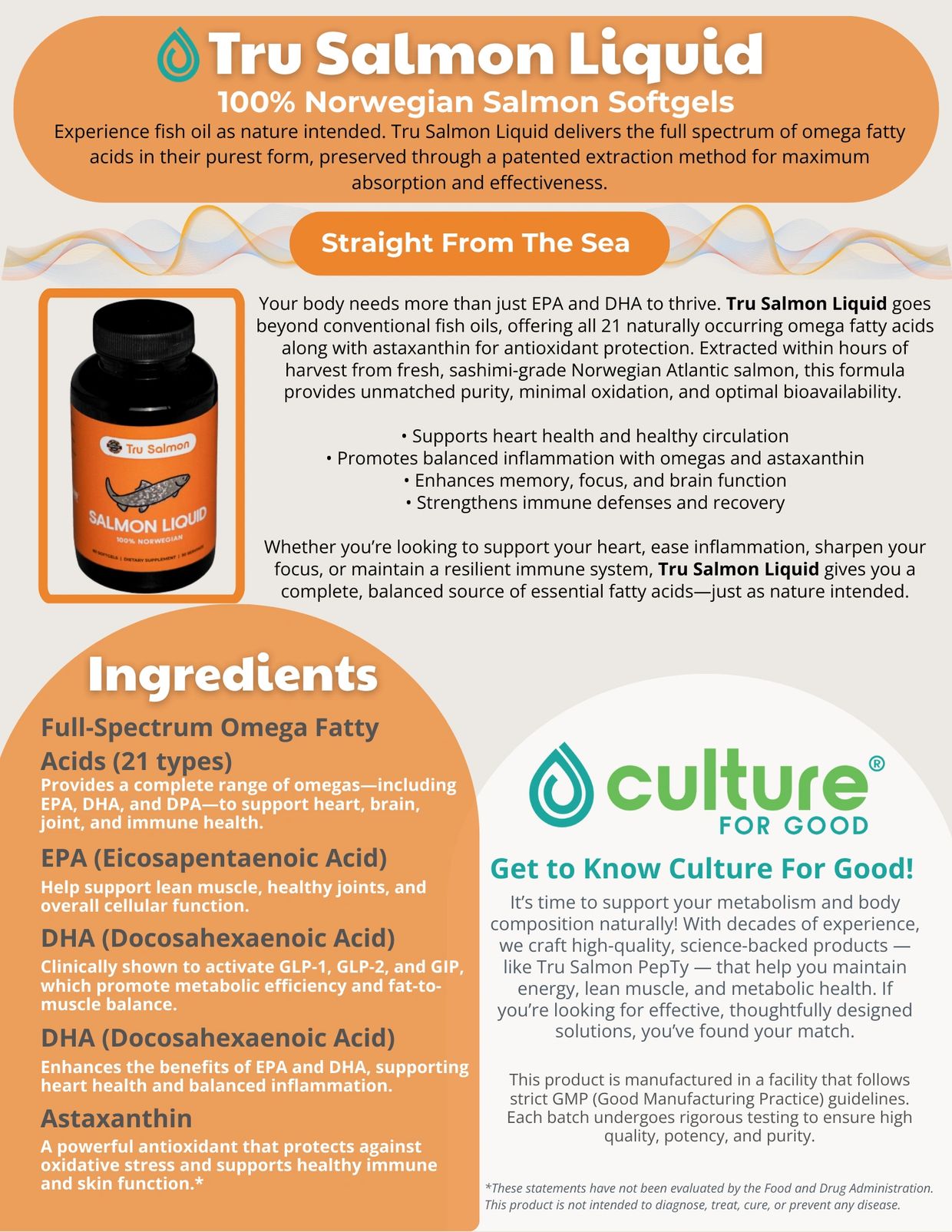
Why Salmon Liquid Matters for the Sales Professional
The product sheet explains what makes Tru Salmon Liquid different.
The larger question for this page is:
Why does that matter to someone in sales?
Because every conversation depends upon a brain and body being asked to perform.
To focus.
Listen.
Remember.
Interpret.
Recognize patterns.
Adapt when the conversation changes.
Regulate emotion when the outcome matters.
And remain present through a demanding day.
Tru Salmon Liquid doesn’t give you those capabilities.
They are already part of you.
Its role is to help support the broader nutritional foundation of the biological system through which those capabilities have to be expressed.
And unlike something designed to produce an immediate sensation or short-term performance boost, foundational support may not always be something you consciously feel in the moment.
That doesn’t make it less important.
It means its role is deeper.
Flo helps support the digestive process responsible for breaking down and making use of the nutrition coming in.
Tru Salmon Liquid helps support the broader nutritional foundation underneath the person you’re asking to think, communicate, connect, and perform.
Different forms of support.
One connected receiver.
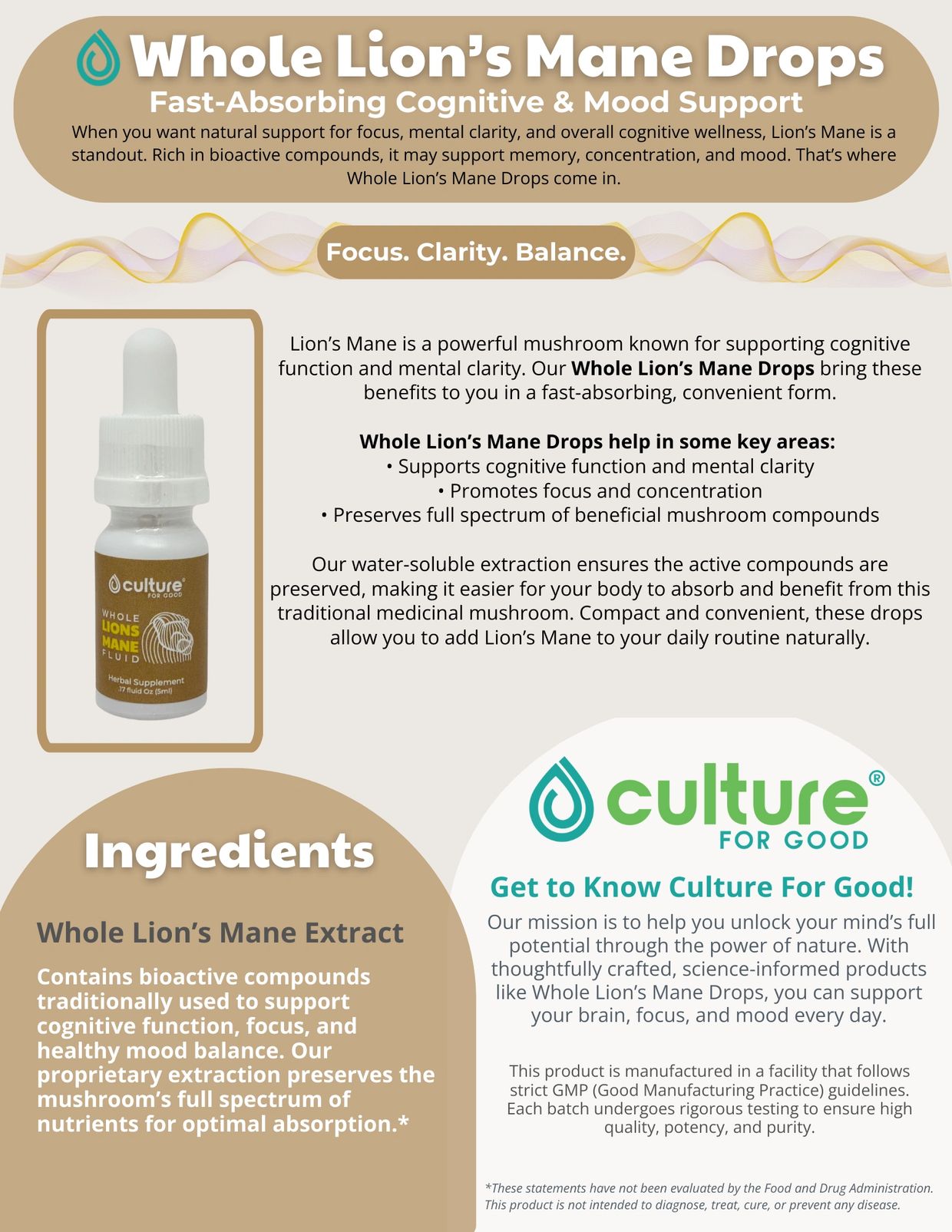
Why Whole Lion’s Mane for Sales Professionals?
Sales is an intensely cognitive activity.
Every conversation asks you to process information in real time.
To remain focused.
Listen closely.
Remember what someone told you earlier.
Recognize patterns.
Interpret what may be underneath the words.
Adapt when the conversation changes direction.
And respond without losing your connection to the person in front of you.
Those are some of the same innate capabilities we’ve been exploring throughout this page.
That’s why Lion’s Mane earned a place in this sales-focused collection.
But not every Lion’s Mane product is the same.
Some products are made primarily from the mushroom’s fruiting body.
Others focus on the mycelium—the network from which the mushroom grows.
Culture For Good’s Whole Lion’s Mane includes both.
Why does that matter?
Because the fruiting body and the mycelium contain different naturally occurring compounds.
The fruiting body contains hericenones.
The mycelium contains erinacines.
And both contribute polysaccharides, including beta-glucans.
By including the complete mushroom—both the fruiting body and the mycelium—Culture For Good preserves access to a broader spectrum of the naturally occurring compounds found throughout Lion’s Mane.
That is what makes it Whole Lion’s Mane.
And it reflects the same philosophy we saw with Tru Salmon Liquid:
Don’t automatically isolate one or two familiar components and discard the rest.
Begin with the complete natural source and preserve more of what was already there.
For a sales professional, Whole Lion’s Mane is not a substitute for preparation, product knowledge, experience, or communication skills.
It doesn’t create the capabilities you depend upon.
Its role is to provide nutritional support for healthy cognitive function and the biological system through which your focus, memory, pattern recognition, creativity, adaptability, and mental clarity have to be expressed.
The capabilities are already there.
The opportunity is to support the receiver through which you access them.

Why the Endocannabinoid System Matters for Sales Professionals
The product sheet explains what makes Culture For Good’s Whole Flower Hemp Drops different.
The larger question for this page is:
Why does supporting the endocannabinoid system matter to someone in sales?
The endocannabinoid system—or ECS—is one of the body’s foundational communication networks.
It plays an important role in helping the body maintain balance while continually responding to changing internal and external conditions.
And changing conditions are a constant part of selling.
An unexpected objection.
A prospect who doesn’t respond.
Pressure around a goal.
A conversation that changes direction.
A disappointing outcome.
A long day followed by one more important meeting.
Each experience can influence the state you carry into whatever happens next.
Within the Human Capability Project, that matters because your ability to remain calm, think clearly, regulate emotion, adapt, recover, and return to a more supportive state is expressed through a body that is constantly receiving, processing, and responding to information.
Whole Flower Hemp Drops don’t create those capabilities.
They are already part of you.
Their role is to support the endocannabinoid system—one of the biological systems helping the receiver continually regulate, recover, adapt, and work toward balance.
This isn’t about taking CBD simply because sales can be stressful.
It’s about supporting one of the foundational communication systems within the person experiencing that stress.
Because every difficult conversation eventually ends.
The more important question may be:
What state are you able to bring into the conversation that follows?

Why Blue Lotus for Sales Professionals?
The product sheet explains the history of Blue Lotus and the qualities Culture For Good designed its whole-flower extract to preserve.
The larger question for this page is:
Why does supporting calm and emotional balance matter to someone in sales?
Sales doesn’t only require the ability to turn your attention and intensity on.
Sometimes the larger challenge is being able to turn them down.
A conversation that keeps replaying in your mind.
A prospect who still hasn’t responded.
A goal you’re worried about reaching.
An outcome you wish had gone differently.
Or a full day of professional demands that follows you long after the work itself has ended.
That matters because the state you carry out of one day can influence the condition in which you begin the next.
Blue Lotus was traditionally used as a calming botanical, and Culture For Good’s whole-flower extract is designed to support relaxation, emotional balance, and a greater sense of well-being.
Its role within this sales-focused collection is different from Flo, Tru Salmon Liquid, Whole Lion’s Mane, or Hemp Drops.
This isn’t about improving one particular sales skill.
And it isn’t about becoming less driven, less focused, or less ambitious.
It’s about supporting the other side of sustained performance:
The ability to settle.
Recover.
Release some of the emotional residue of the day.
And create enough internal space to return to a calmer, more balanced state.
Because sometimes greater access doesn’t come from pushing harder.
Sometimes it comes from supporting the conditions that allow your attention, clarity, and emotional stability to return more naturally.
That makes Blue Lotus an appropriate final product in this collection.
We began with digestion.
Then supported the broader nutritional foundation.
Added cognitive support.
Explored the endocannabinoid system.
And finally, created space for calm and emotional balance.
Different forms of support.
One connected receiver.

A Broader Toolkit for Supporting the Receiver
The five products highlighted on this page were selected because they provide clear examples of different ways the biological foundation behind professional performance can be supported.
Flo supports digestion and nutrient utilization.
Tru Salmon Liquid supports the broader nutritional foundation.
Whole Lion’s Mane provides cognitive support.
Whole Flower Hemp Drops support the endocannabinoid system.
Blue Lotus supports calm and emotional balance.
But those are only five examples.
The Culture For Good line goes much deeper.
Additional formulations include:
Blend V — Whole-Food Vitamin Support
A daily blend of whole-food, water-soluble vitamins designed to provide nutrients the body uses regularly and needs to replenish through diet.
Blend M — Bioavailable Mineral Support
A carefully formulated mineral blend using amino acid chelates, designed to help fill nutritional gaps with forms intended to be gentle on digestion and readily absorbed.
Proteo — Proteolytic Enzyme Support
Plant-based proteolytic enzymes designed to support healthy recovery, joint function, and the digestion of high-protein meals, shakes, and bars.
Hops Drops — Vagus Nerve and Gut-Brain Support
Designed to support gut-brain communication, digestive signaling, and a calmer internal state.
Beet Root Drops — Circulation and Endurance Support
A whole-plant beet-root extract designed to support healthy circulation, nutrient delivery, and physical endurance.
Addy Drops and Escalate — Focus Support
Two different formulations created to provide nutritional support for focus and sustained attention during work, learning, and everyday activity.
Biome Balance — Probiotic and Prebiotic Support
Features spore-based probiotics and prebiotics designed to support microbial balance and digestive health.
Transform and Creatine+ Gummies — Muscle, Energy, and Recovery Support
Designed for people who want additional nutritional support around strength, physical activity, energy metabolism, and recovery.
Soursop Drops — Cellular and Immune Support
Rich in naturally occurring phytonutrients that support healthy cellular defense, immune function, and oxidative balance.
Parasite Drops — Digestive Support
A botanical formulation designed to support healthy digestion and digestive comfort.
Support for Pets
The Culture For Good line isn’t limited to people. It also includes nutritional products formulated specifically to support the health and everyday well-being of pets—extending the company’s whole-source nutritional philosophy to other members of the family.
Why does that breadth matter?
Because the person you’re asking to think, listen, interpret, communicate, adapt, recover, and regulate emotion is not made up of isolated systems.
Digestion matters.
The gut-brain connection matters.
Circulation matters.
Nutrient availability matters.
Vitamins and minerals matter.
Microbial balance matters.
Cognitive function matters.
Emotional state matters.
Energy matters.
Recovery matters.
And different people may benefit from support in very different places.
That’s why we don’t look at Culture For Good as simply a collection of individual supplements.
We see it as a broad nutritional toolkit for supporting the biological receiver from multiple directions.
The point is not that every sales professional needs every product.
The larger idea is much simpler:
Support the receiver because the receiver is the vehicle through which your preparation, experience, and innate capabilities ultimately have to be expressed.

Meet the Morning Reset
Everything we’ve explored on this page comes back to one central idea:
Get out in front of the conditions that influence your access.
That’s the thinking behind the Morning Reset.
The Morning Reset is a 15-minute daily conditioning practice designed to help you intentionally prepare your mental and emotional state before the demands of the day begin.
Because a day in sales can begin creating emotional momentum before you have your first conversation.
The goal you’re working toward.
The prospect who hasn’t responded.
The meeting coming later.
The conversation that didn’t go well yesterday.
The number you’re expected to reach.
Everything waiting in your inbox.
And before the day has really started, you may already feel:
Pressured.
Distracted.
Frustrated.
Behind.
Uncertain.
Or overly attached to what needs to happen next.
That state can begin influencing what you notice, how you interpret events, and how you respond to everything that follows.
That’s momentum.
And momentum can build in either direction.
What if, before the emails…
Before the calls…
Before the meetings…
Before the expectations…
And before everyone else begins competing for your attention…
You intentionally spent a few minutes creating momentum toward states like:
Love.
Appreciation.
Abundance.
Joy.
Calm.
Clarity.
Focus.
Confidence.
Emotional stability.
Not because that guarantees every conversation will go your way.
And not because frustration, disappointment, uncertainty, or pressure mean something is wrong.
The purpose is to give yourself another place to come from.
Through Intentional Emotional Rehearsal, the Morning Reset helps you practice greater access to the emotional states you want more consistently available.
In the short term, that can help you begin the day with more intentional emotional momentum.
Over time, consistent repetition can help you build a stronger emotional baseline—the range of states that has become familiar enough for your system to access and return to more easily.
That means the Morning Reset is working on two things at the same time:
Creating better emotional momentum for the day in front of you.
And intentionally conditioning the emotional baseline you tend to return to over time.
Because the goal isn’t to become someone different.
It’s to prepare the person who has to bring everything you already know into every conversation that follows.

Experience It for Yourself
Understanding the Morning Reset is one thing.
Experiencing it is different.
The five-minute audio below was created using the opening and closing portions of the complete Morning Reset.
The opening allows you to experience the guided process used to help you settle and become more receptive.
The emotional rehearsal itself is not included in this sample.
That means you will not experience the approximately ten minutes devoted to intentionally rehearsing states such as love, appreciation, abundance, joy, calm, clarity, focus, confidence, and emotional stability.
Instead, the sample transitions from the opening into the closing portion of the Morning Reset.
The sound you’re hearing is part of the process—not simply a backdrop.
Across the full 15-minute Morning Reset, the soundscape changes deliberately as the practice unfolds, with different sounds used at specific moments to support Alpha, Theta, Delta, and Gamma brainwave activity.
It isn’t the complete practice.
It is a short sample designed to give you a feel for the sound, pacing, and overall vibe of the full Morning Reset experience.
For the best experience, use earbuds or headphones so you can experience the carefully layered sounds as they were designed to be heard.
What Others Have Experienced With Morning Reset


Make It Part of Your Day
You’ve explored what influences your access.
You’ve seen how repeated emotional states can create momentum and shape the baseline you return to.
And you’ve had an opportunity to experience the sound, pacing, and overall vibe of the Morning Reset.
The next logical step is to experience the complete practice for yourself.
The Morning Reset is more than a 15-minute audio.
It is a complete personal-development program designed to help you intentionally condition your emotional baseline—and observe how that conditioning influences the way you think, listen, communicate, respond, and perform over time.
Your Morning Reset Program Includes
The Complete 15-Minute Morning Reset
This is the full daily practice, including approximately ten minutes of Intentional Emotional Rehearsal designed to help you create momentum toward love, appreciation, abundance, joy, calm, clarity, focus, confidence, and emotional stability.
The 5-Minute Quick Reset
A shorter practice for when you need an intentional reset before an important meeting, presentation, sales conversation, or decision.
The Baseline Questionnaire
A guided self-assessment designed to help you establish a clear picture of where you are beginning.
It invites you to consider your current patterns of focus, confidence, emotional stability, reactivity, decision-making, communication, and recovery when something disrupts your state.
The Progress Tracker
A practical tool for observing what changes as the practice becomes part of your routine.
Because development is often gradual, the tracker helps you recognize shifts you might otherwise overlook—such as recovering more quickly, listening more fully, responding more thoughtfully, or maintaining greater clarity under pressure.
Together, the questionnaire and progress tracker transform Morning Reset from an audio you listen to into a development process you can actively observe.
You aren’t simply practicing for a better morning.
You are intentionally strengthening the emotional baseline you bring into every conversation that follows.
Immediate Access. Lifetime Use.
Your complete Morning Reset program is available for a one-time investment of $88.
There is no subscription.
You’ll receive immediate access to the complete program, and it remains available to you for life.
It is also protected by a 30-day guarantee, giving you the opportunity to experience the practice and determine whether it belongs in your day.
You already possess the capabilities.
The Morning Reset is an opportunity to support more consistent access to them.
For Sales Teams and Organizations
Most sales training focuses on what people should do.
Ask better questions.
Listen more closely.
Communicate clearly.
Build trust.
Adapt when the conversation changes.
Respond effectively to objections.
Recover quickly from rejection.
Those skills matter.
But every one of them depends upon something even more foundational:
The salesperson’s ability to consistently access the human capabilities required to apply those skills when the pressure is on.
A sales professional may know how to listen.
But can they still listen when they’re worried about reaching a number?
They may know how to build trust.
But can they remain present when they’ve become attached to the outcome?
They may know how to ask better questions.
But can they access the curiosity, intuition, and discernment needed to recognize which question matters most?
That is the layer the Human Capability Project was designed to explore.
Foundational Sales Training
This framework doesn’t replace the sales training your team already has.
It supports the people responsible for applying it.
The Human Capability Project introduces sales professionals to the conditions that can influence their access to attention, listening, intuition, discernment, creativity, adaptability, emotional regulation, and genuine human connection.
Morning Reset provides a practical daily conditioning program for intentionally building emotional momentum and strengthening the emotional baseline they bring into their work.
The broader Supporting the Receiver framework introduces the biological conditions that can also influence how consistently those capabilities remain available.
Together, they create a more foundational approach to professional development—one centered on preparing the person who must bring everything they know into every conversation.
What Could Change If Your Team Had More Consistent Access?
More attentive listening.
Clearer thinking under pressure.
More natural communication.
Greater emotional stability following rejection.
More thoughtful responses.
Stronger adaptability when conversations change direction.
Less attachment to individual outcomes.
And a greater ability to remain genuinely connected to the person in front of them.
No program can guarantee the outcome of every conversation.
But organizations can become more intentional about supporting the internal conditions their people bring into those conversations.
If you lead a sales team, train sales professionals, or support the development of people whose performance depends upon human interaction, I would welcome a conversation about how this framework might support your organization.
Because your team may not need another sales technique.
They may need more consistent access to the capabilities their existing techniques already depend upon.