
The Human Capability Project
You Knew What to Do. So What Happened?
You dropped a ball that was right in your hands.
You made a pass you knew was wrong.
You missed an open net you normally bury.
You rushed a decision you’ve made correctly hundreds of times.
You didn’t see the hit coming—and you know you should have.
Then, seconds later, you knew exactly what you should have done.
So what happened?
You didn’t suddenly lose your ability.
The capability was still there.
Something changed in your ability to access it.
Under pressure, athletes can temporarily lose access to the very capabilities they rely on:
Focus.
Awareness.
Timing.
Confidence.
Communication.
Decision-making.
Pattern recognition.
The ability to anticipate what happens next.
You might call it nerves.
Pre-match anxiety.
Overthinking.
Getting inside your own head.
Choking under pressure.
Those words describe the experience.
But they don’t fully explain what happened.
Your sport unfolds moment by moment.
You don’t have three or four minutes to regain your focus, recognize the opening, or remember what you already know.
The opportunity may be gone in the blink of an eye.
That’s why performance isn’t determined only by the capabilities you possess.
It’s shaped by how consistently you can access those capabilities while the game is moving, the pressure is rising, and your emotional state is changing.
The more stable your baseline becomes, the less likely those moments are to pull you completely away from what you know and what you can do.
And when they do, you may be able to return more quickly.
Your sport isn’t only testing what you can do in practice.
It’s testing what you can consistently access when the pressure is on.
That is why more consistent access to your innate capabilities is your most valuable competitive asset.
And it raises an important question:
What influences how consistently you can access the capabilities you already possess—especially when the pressure is on?
That question is at the heart of the Human Capability Project.

What Does That Actually Mean?
For years, I’ve been exploring a much bigger question:
What are human beings actually capable of?
My exploration began many years ago with Neuro-Linguistic Programming.
From there, it expanded through a number of different lenses:
Law of Attraction.
Meditation.
Spirituality.
Energy work.
Consciousness.
Different approaches.
Different language.
Different explanations for what may be happening.
But underneath all of them was the same fascination:
There seemed to be far more going on within us than most of us ever stop to consider.
Over time, that exploration led me to a simple statement that became the foundation of my work:
You Are Powerful Beyond Measure.
Eventually, that statement raised another question:
How are we powerful beyond measure?
Over time, I came to realize that the answer was much more practical than I had originally imagined.
It’s because of the remarkable innate capabilities we possess simply as part of being human.
Consider how many of those capabilities you rely on every time you train or compete.
Attention and focus — staying connected to what matters while everything around you is moving, changing, and competing for your attention.
Pattern recognition — recognizing formations, tendencies, movement, positioning, and what may be developing before it fully happens.
Decision-making — processing information quickly enough to make the right choice when there may be very little time to think about it.
Anticipation — sensing what may be coming next based on everything you’ve learned, observed, and experienced.
Spatial awareness — knowing where you are in relation to teammates, opponents, boundaries, openings, and movement around you.
Adaptability — adjusting when the game changes, the opponent does something unexpected, a play breaks down, or the original plan no longer works.
Emotional regulation — staying connected to yourself after a mistake, a bad call, a missed opportunity, a momentum shift, or a high-pressure moment.
Confidence — trusting your preparation and your abilities enough to act decisively when the moment arrives.
Communication — reading people, sending information, responding quickly, and staying connected with teammates under pressure.
Creativity — recognizing possibilities that may not have been scripted or practiced exactly the way they appear in competition.
Problem-solving — figuring out what to do when what normally works suddenly doesn’t.
And those are only some of the capabilities you consciously recognize.
Your biology is also continuously supporting performance through remarkable innate capacities of its own.
Interoception — sensing what is happening inside your body.
Proprioception — knowing where your body is and how it is moving without having to consciously watch every movement.
Homeostasis — continuously regulating internal conditions to help keep your system functioning.
Allostasis — anticipating changing demands and
preparing your body to respond.
Implicit learning — learning patterns, movements, associations, and responses without consciously thinking through every step.
Neuroplasticity — your brain’s ability to change and reorganize through training, repetition, and experience.
Think about how much athletic performance depends on access to those capabilities.
Seeing something develop before everyone else does.
Making a decision in a fraction of a second.
Staying composed after a mistake.
Recognizing an opening.
Adjusting when the original play breaks down.
Communicating without needing a long conversation.
Trusting your preparation when the pressure rises.
Responding instead of hesitating.
Recovering emotionally before the next play begins.
Staying focused when fatigue starts changing what feels available.
Your training matters.
Your preparation matters.
Your coaching matters.
Your strength matters.
Your conditioning matters.
Your skill development matters.
But ultimately, all of it has to be expressed through you when the moment demands it.
That’s when You Are Powerful Beyond Measure stops sounding like an inspirational statement.
It starts looking more like an observation.
If You Already Possess All of These Capabilities…
Why are they easier to access some days than others?
Why can you walk into practice one day and everything feels sharp…
And the next day feel half a step behind?
Why can you see the play developing almost before it happens…
Then miss something you normally recognize immediately?
Why can you feel completely confident early in a game…
Then make one mistake and suddenly start second-guessing yourself?
Why can you stay composed under pressure one day…
And get frustrated, distracted, or emotionally thrown off the next?
Why can your reactions feel automatic when you’re fresh…
Then require much more effort when fatigue starts setting in?
Your talent didn’t suddenly change.
Your training didn’t disappear.
Your capabilities didn’t disappear.
Your access changed.
And that access can be influenced by a lot of things:
Stress.
Sleep.
Fatigue.
Emotional state.
Expectations.
Pressure.
Nutrition.
Hydration.
Recovery.
Your environment.
Your nervous system.
And the patterns you’ve been repeatedly practicing.
That’s why two versions of you can sometimes feel completely different even though the same athlete is still there.
Same training.
Same capabilities.
Different state.
And when your state changes, what you can easily access can change with it.
Your focus.
Your confidence.
Your decision-making.
Your reaction time.
Your emotional stability.
Your ability to recognize what matters.
Your ability to adapt.
Your ability to trust what you already know.
That raises a much more useful question than:
“What’s wrong with me today?”
The better question may be:
“What is influencing my access right now?”
Because once you begin thinking in terms of access, you can start exploring something much more practical:
How can I create conditions that make more of what I’m already capable of consistently available when performance demands it?

Getting Out in Front of It
As an athlete, you already understand that practice is preparation.
But practice isn’t only physical.
Think about some of the things you may experience during a normal week of training.
A drill doesn’t go the way you wanted.
You make a mistake you normally wouldn’t make.
A coach gives you feedback that gets your attention.
You’re tired and your timing feels a little off.
You start thinking about an upcoming competition.
You wonder how much you’ll play.
How you’ll perform.
Whether you’re fully ready.
None of that is unusual.
It’s part of being an athlete.
But those moments can also bring up familiar emotional responses.
Frustration.
Doubt.
Anxiety.
Pressure.
Or sometimes simply feeling a little less confident than you did before.
And just as repetition helps make physical movements and responses more familiar, repeated emotional responses can become familiar too.
Sometimes without you even realizing it.
That raises an interesting question:
If emotional responses can become more familiar through repetition, can you intentionally practice the states you would rather have more available?
Calm.
Focus.
Confidence.
Composure.
Emotional stability.
The ability to reset and move on.
Not because you expect frustration, anxiety, or doubt to disappear.
But because you can become more practiced at accessing the states you want available when those moments show up.
That brings us to another form of preparation:
Intentional Emotional Rehearsal.

Intentional Emotional Rehearsal
If repetition can make emotional responses more familiar, then the same principle can be used intentionally.
That’s the idea behind Intentional Emotional Rehearsal.
Instead of waiting until pressure arrives to look for confidence…
Or waiting until frustration shows up to look for composure…
Or waiting until your attention starts drifting to look for focus…
you deliberately practice greater access to those states before you need them.
Calm.
Focus.
Confidence.
Composure.
Emotional stability.
The ability to reset.
The ability to stay connected to what matters.
Not because you expect to eliminate frustration, doubt, anxiety, or pressure.
Those experiences are part of competition.
The opportunity is to become more practiced at accessing and returning to the states that help you respond the way you want when those moments occur.
And that matters because your emotional state can influence what feels available to you in the moment.
Your focus.
Your decision-making.
Your confidence.
Your emotional stability.
Your ability to recognize what is developing.
Your adaptability when something changes.
Your ability to recover from a mistake.
Your ability to trust what you already know.
The capabilities are already there.
Intentional Emotional Rehearsal is about making supportive emotional states more familiar, so when the pressure is on, you may be better able to access the focus, confidence, emotional stability, composure, decision-making, and adaptability you already possess.
You’re not practicing the capability. You’re practicing the state from which greater access to that capability may become possible.
We’re going to come back to this idea later and give you an opportunity to experience what this type of practice can feel like for yourself.
But emotional conditioning is only one part of getting fully out in front of performance.
Because every thought, decision, reaction, movement, and emotional response is being expressed through a living biological system.
And athletes already place enormous demands on that system.
Training.
Competition.
Recovery.
Travel.
Sleep.
Nutrition.
Hydration.
Repeated physical and mental stress.
So before we return to emotional rehearsal, let’s look at the other side of the equation:
How are you supporting the biological foundation through which all of those capabilities have to be expressed?
Why Culture For Good Uniquely Supports the Foundation Behind the Athlete
We don’t need to teach you about functional nutrition.
In fact, depending on what you’re studying and how deeply you’ve explored performance nutrition, you may know more about certain aspects of it than we do.
You already understand the role nutrition and supplementation can play in training, recovery, adaptation, and performance.
What we want to show you is why Culture For Good fits so naturally into the Human Capability Project — and why we see the line as foundational support for the athlete behind the performance.
Culture For Good brings more than 20 years of experience in whole-food, plant-based functional nutrition, including years of working with NCAA and professional athletes.
And when you’re choosing any nutritional supplement, there are several important questions worth asking.
First: sourcing.
Where did it come from?
What was the original plant, food, or biological source?
What was the quality of that source before anyone turned it into a supplement?
Second: processing and extraction.
What happened to the original source?
Was heat used?
Were chemicals involved?
Was alcohol used?
How was the material processed, extracted,
concentrated, and preserved?
Because what you start with matters.
And what you do to it afterward matters too.
Which leads to another important consideration:
Bioavailability.
Once you consume the product, how readily can your body make use of what’s there?
That’s where sourcing, processing, and extraction become especially relevant.
And it’s one of the reasons Culture For Good caught our attention.
Before we get into the individual products, take a couple of minutes to hear from Sean Loomer, one of the founders of Culture For Good, as he explains the philosophy behind the line, the extraction technology, and the experience the company has developed over more than two decades.
Video: 2:37
Then we can move directly into the first foundational question:
How effectively are you breaking down and making use of the nutrition you’re already consuming?
Before You Add More, Start With Digestion
As an athlete, you already put considerable thought into what you consume.
Protein.
Carbohydrates.
Healthy fats.
Electrolytes.
Vitamins.
Minerals.
Functional supplements.
Recovery nutrition.
But consuming something is only the beginning.
Your digestive system still has to break food down and make those nutrients available for absorption and use.
Which raises a foundational question:
How effectively are you making use of what you’re already putting into your body?
That matters whether you’re eating an incredibly disciplined diet or investing heavily in nutritional supplementation.
So before we start talking about adding another ingredient or another performance product, it makes sense to look at the system responsible for processing what is already coming in.
That’s why digestion is where we start.
And rather than simply tell you why Culture For Good places so much importance on digestive support, we want you to hear it directly from Tylene Loomer, the other founder of Culture For Good.
In the short video below, Tylene explains the role digestion plays in making use of the nutrition you’re already consuming — and introduces one of the foundational products in the Culture For Good line:
Flo.

If You Already Take Fish Oil, What’s Different Here?
For many athletes, omega supplementation is already part of the routine.
So this isn’t really about convincing you to take fish oil.
It’s about looking more closely at what’s actually in the product you’re already taking — and how it got there.
A lot of conventional fish-oil products are built primarily around concentrated amounts of EPA and DHA.
Those are important fatty acids.
But they aren’t the only fatty acids naturally present in salmon.
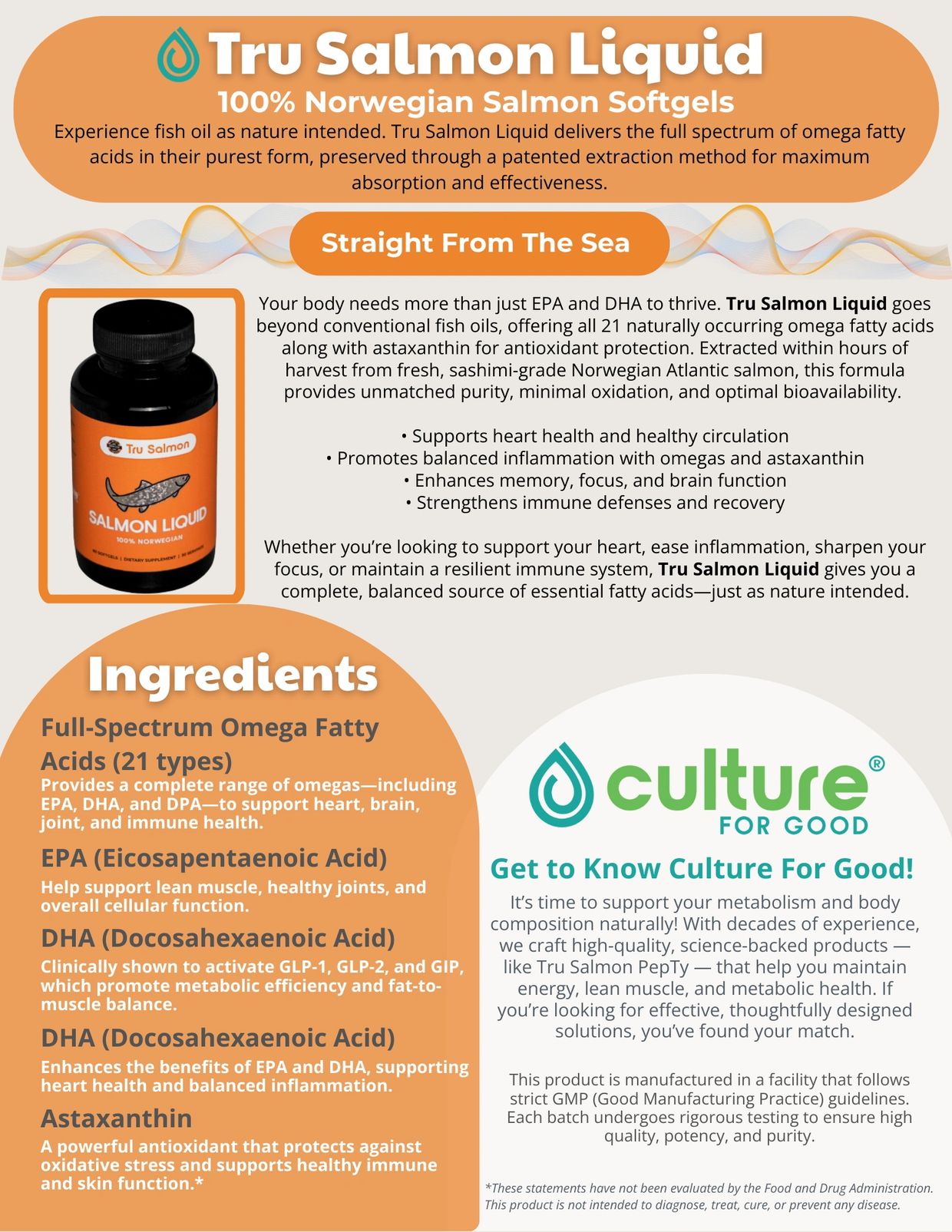
Tru Salmon Liquid takes a broader approach.
It begins with fresh Norwegian Atlantic salmon and is designed to preserve a naturally occurring spectrum of 21 omega fatty acids — including EPA, DHA and DPA — along with naturally occurring astaxanthin.
That takes us right back to the questions we raised earlier:
What was the original source?
How was it processed?
How much of the naturally occurring nutritional profile was preserved?
Culture For Good’s approach is not simply to isolate one or two compounds and discard the rest.
The philosophy is to preserve more of what was naturally present in the original food source.
For an athlete who is already spending money on fish oil, that creates a very practical question:
Do I want an isolated omega product — or a broader nutritional profile that more closely reflects the original source?
You may not need another supplement in your routine.
You may simply decide there’s a better way to fill a nutritional need you’re already addressing.

You May Already Use Beet Root. So Why This One?
For many athletes, beet root isn’t new.
You may already be using a powder, capsule, gummy, or pre-workout product that includes it.
So once again, the question isn’t:
Why should I take beet root?
The better question is:
What form am I taking, how was it processed, and what am I actually getting from it?
That brings us back to the same criteria we introduced earlier:
The quality of the original source.
The extraction process.
The delivery format.
And how much of the original plant profile is preserved.
Culture For Good takes beet root in a different direction than the powders, capsules, and gummies many athletes are accustomed to using.
Rather than simply adding another beet product to your routine, it gives you an opportunity to compare the product you’re already using against a different approach to sourcing, extraction, and delivery.
If beet root is already part of your performance nutrition, the question may not be whether to use it.
The question may simply be whether there’s a better way to get it.
If Lion’s Mane Is Already Part of Your Routine
For a lot of athletes, Lion’s Mane isn’t new.
You may already be using it for focus, mental clarity, concentration, or general cognitive support.
So once again, we’re not trying to introduce you to the category.
We want you to look more closely at the product itself.
Culture For Good uses a whole Lion’s Mane extract and a water-soluble extraction process designed to preserve a broader spectrum of the mushroom’s naturally occurring compounds.
That brings us right back to the questions we raised earlier:
What was the original source?
How was it processed?
What was preserved?
And how readily can your body make use of what remains?
For an athlete, that conversation is especially relevant because so much of performance depends on what is happening above the shoulders.
Focus.
Recognition.
Learning.
Decision-making.
Adaptability.
Mental clarity.
The ability to stay connected to what matters while everything around you is moving quickly.
Those are some of the same innate capabilities we started this entire page talking about.
So if Lion’s Mane is already part of your routine, the question may not be whether you should take it.
The question may simply be:
Is the Lion’s Mane you’re currently using giving you the kind of whole-source support you actually want?

And Those Are Only Four Examples
The four products we’ve highlighted were chosen because they give us useful examples of different ways the biological foundation behind athletic performance can be supported.
But the Culture For Good line goes much deeper.
Additional formulations include:
Transform — Training + Muscle Support
Designed for active men and women, from highly trained athletes to weekend warriors.
Transform combines creatine, magnesium, glutamine, and branched-chain amino acids to support normal muscle function, strength, energy metabolism, and recovery.
It also features magnesium creatine chelate — a patented form combining creatine and magnesium into a single molecule.
Creatine+ Monohydrate Gummies — Strength + Energy + Focus Support
A convenient creatine option combining creatine monohydrate with L-theanine, black currant powder, vitamin B12, and fiber.
Designed to support normal muscle energy metabolism, strength and endurance, recovery, and calm mental focus.
And it gives athletes another way to incorporate creatine without adding another powder or capsule to their routine.
Proteo — Proteolytic Enzyme Support
Plant-based proteolytic enzymes designed to support healthy recovery, joint function, and the digestion of high-protein meals, shakes, and bars.
Hops Drops — Vagus Nerve + Gut-Brain
Support
Supports gut-brain signaling and digestive communication pathways while promoting calm, appetite balance, and digestive rhythm.
Escalate — Focus Support
Provides nutritional support for focus during work, school, training, or physical activity.
Biome Balance — Probiotic + Prebiotic Support
Features spore-based probiotics and prebiotics designed to support microbial balance and digestive health.
Blue Lotus — Calm + Emotional Balance Support
Designed to support a calmer internal state and greater emotional balance.
Addy Drops — Cognitive Support
A functional formulation designed to support focus and sustained attention.
Soursop Drops — Cellular + Immune Support
Rich in phytonutrients that support healthy cellular defense, immune function, and oxidative balance.
Parasite Drops — Digestive Support
Designed to support healthy digestion and digestive comfort with a blend of natural ingredients and proprietary extracts.
Why Does That Breadth Matter?
Because the athlete you’re asking to train, compete, think, react, learn, adapt, recover, and regulate emotion is not made up of isolated systems.
Digestion matters.
The gut-brain connection matters.
Circulation matters.
Nutrient availability matters.
Microbial balance matters.
Cognitive function matters.
Emotional state matters.
Muscle function matters.
Recovery matters.
And different athletes may benefit from support in very different places.
That’s why we don’t look at Culture For Good as simply a collection of individual supplements.
We see it as a broad nutritional toolkit for supporting the biological foundation behind the athlete from multiple directions.
The point is not that every athlete needs every product.
The larger idea is much simpler:
Support the receiver because the receiver is the vehicle through which your training, preparation, and innate capabilities ultimately have to be expressed.
Now Let’s Come Back to Intentional Emotional Rehearsal
Earlier, we introduced the idea that emotional responses can become more familiar through repetition.
Frustration can become familiar.
Doubt can become familiar.
Anxiety can become familiar.
But so can:
Calm.
Focus.
Confidence.
Composure.
Emotional stability.
The ability to reset and move on.
That’s the idea behind Intentional Emotional Rehearsal.
You’re not trying to eliminate every difficult emotion you may experience as an athlete.
And you’re not pretending pressure doesn’t exist.
You’re deliberately practicing greater access to the emotional states you would rather have available when the pressure arrives.
Because when your state changes, what feels readily available can change with it.
Your focus.
Your confidence.
Your decision-making.
Your emotional stability.
Your ability to recognize what’s developing.
Your ability to adapt.
Your ability to recover after a mistake.
Your ability to trust what you already know.
The capabilities are already there.
The practice is about making the states that support greater access to those capabilities more familiar.
And that’s exactly why I created the Morning Reset.
A Practical Way to Practice It
Understanding Intentional Emotional Rehearsal is one thing.
Practicing it consistently is another.
That’s why I created the 15-Minute Morning Reset.
It’s a daily conditioning practice designed to help you intentionally rehearse greater access to emotional states such as:
Love.
Appreciation.
Abundance.
Joy.
Calm.
Focus.
Confidence.
Emotional stability.
Not because an athlete needs to walk around feeling all of those things every minute of the day.
The purpose is repetition.
To make supportive emotional states more familiar.
More accessible.
And easier to return to when training, competition, pressure, frustration, or everyday life starts pulling you somewhere else.
For an athlete, think of it the same way you think about any other form of practice:
You don’t wait until the moment of competition to begin rehearsing what you want available when you get there.
How and Why the Morning Reset Works
The Morning Reset is built around a simple idea:
What you repeatedly practice becomes more familiar.
Athletes already understand this physically.
You repeat movements.
You repeat plays.
You repeat reactions.
You repeat skills until they require less conscious effort and become easier to access when you need them.
The Morning Reset applies that same principle to emotional state.
During the 15-minute practice, you intentionally move through a sequence of states:
Love.
Appreciation.
Abundance.
Joy.
Calm.
Focus.
Confidence.
Emotional stability.
The practice combines focused attention, breathing, visualization, emotionally meaningful language, repetition, and sound to help you deliberately experience those states rather than simply think about them.
And repetition is the important part.
One session may help you feel different in the moment.
But the larger purpose is conditioning.
Each time you intentionally access calm, you become more familiar with calm.
Each time you practice confidence, you reinforce your familiarity with confidence.
Each time you practice focus, emotional stability, appreciation, or joy, you are giving your mind and body another experience of returning to that state intentionally.
Over time, the goal is for those states to become:
More familiar.
More accessible.
And easier to return to.
That doesn’t mean pressure disappears.
It doesn’t mean you never get frustrated.
It doesn’t mean you never doubt yourself, lose focus, or have a bad day.
It means you’ve spent time practicing something else to return to.
That’s why we refer to this as strengthening your baseline.
Your baseline is not the emotion you experience every second of the day.
It’s the range of states that have become familiar enough that your system knows how to find its way back to them.
And for an athlete, that can matter enormously.
Because you don’t rise to the occasion and suddenly become someone completely different when the pressure is on.
You tend to return to what has become most familiar through repetition.
The Morning Reset gives you a way to intentionally participate in what you’re practicing becoming familiar with.


Experience the Morning Reset for Yourself
You’ve now seen the idea behind Intentional Emotional Rehearsal and how it fits into the full Morning Reset practice.
Below is a shortened 5-minute sample designed to give you a feel for the Morning Reset experience.
One important distinction:
The 5-minute sample does not include the Intentional Emotional Rehearsal portion of the full 15-minute Morning Reset.
That deeper emotional conditioning work is part of the complete practice.
The sample is simply there to let you get a feel for the vibe, the pacing, and the overall experience before deciding whether you want to explore the full 15-minute practice.
Find a place where you can give yourself a few uninterrupted minutes.
Headphones are recommended.
Don’t worry about doing anything perfectly.
Just follow along and notice your experience.
Notice where your attention goes.
Notice how your body responds.
Notice whether you feel any different when you finish than you did when you began.
Then, if the experience resonates with you, the full 15-minute Morning Reset takes the next step by incorporating Intentional Emotional Rehearsal and giving you a structured way to practice greater access to the emotional states you want more consistently available.
The full practice includes approximately 10 minutes of Intentional Emotional Rehearsal work.
Make It Part of Your Day
The 5-minute sample gives you an introduction.
The full Morning Reset is a 15-minute daily conditioning practice designed to help you build greater familiarity with the emotional states you want more consistently available.
And just like physical training, the value comes from repetition.
Not one perfect session.
Not trying to force yourself into a particular emotional state all day.
Consistent practice.
The Morning Reset system includes:
15-Minute Morning Reset
The full daily practice.
It includes approximately 10 minutes of Intentional Emotional Rehearsal designed to help you repeatedly practice greater access to states such as love, appreciation, abundance, joy, calm, focus, confidence, and emotional stability.
5-Minute Quick Reset
A shorter practice designed to help you intentionally reset your state during the day — before practice, before competition, after a difficult moment, or anytime you feel yourself getting pulled away from the state you want to return to.
It is not intended to replace the full 15-minute Morning Reset.
Baseline Reflection
A simple way to become more aware of the emotional states you tend to return to now.
Progress Journal
A way to observe changes over time in what you notice, how you respond, and which states are becoming easier to access and return to.
The process is simple:
Practice.
Reflect.
Observe.
Track.
Repeat.
You already understand what repeated practice can do for a physical skill.
This gives you a way to bring that same intentionality to the person who has to execute those skills.
Special Athlete Pricing
The complete Morning Reset system is normally
$88.
Athletes receive 50% off, bringing the one-time price to:
$44
There is no monthly subscription.
You receive lifetime access to the Morning Reset system.
Use discount code:
ATHLETE50
Because when the moment arrives, your training still has to be expressed through you.
Your focus.
Your confidence.
Your composure.
Your emotional stability.
Your decision-making.
Your ability to adapt.
Your ability to reset after something goes wrong.
Those capabilities already exist.
The opportunity is to create conditions that make more of them consistently available.
Prepare the athlete.
Support the receiver.
Practice the state.
Then let the performance emerge from there.