
The Human Capability Project
Think about a time when you knew something — really knew it — but when the pressure was on, you suddenly couldn’t access it.
Maybe it was during a test.
When someone put you on the spot.
During a presentation.
In a competition.
Your mind went blank in the moment — and five minutes later, the answer was obvious.
You didn’t suddenly lose what you knew.
Something changed in your ability to access it.
We experience versions of this all the time.
And it raises an interesting question:
What influences how consistently you can access the capabilities you already possess?
That question is at the heart of the Human Capability Project.

The Human Capability Project Began Long Before It Had a Name.
My exploration began many years ago with Neuro-Linguistic Programming.
From there, it expanded through a number of different lenses:
Law of Attraction.
Meditation.
Spirituality.
Energy work.
Consciousness.
Different approaches.
Different language.
Different explanations for what may be happening.
But underneath all of them was the same fascination:
There seemed to be far more going on within us than most of us ever stop to consider.
Over time, that exploration led me to a simple statement that became the foundation of my work:
You Are Powerful Beyond Measure.
Eventually, that statement raised another question:
How are we powerful beyond measure?
Consider some of the capabilities you already possess simply because you are human.
Attention and focus — directing your awareness toward what matters and staying with it.
Memory and recall — retaining what you learn and being able to access it when you need it.
Pattern recognition — noticing connections, recurring themes and relationships that may not be immediately obvious.
Problem-solving — recognizing possibilities and finding your way through challenges.
Creativity — generating new ideas, perspectives and solutions.
Imagination — experiencing possibilities internally before they exist externally.
Intuition — sensing or knowing something without consciously reasoning through every step.
Discernment — recognizing what fits, what doesn’t and what deserves your attention.
Empathy and connection — recognizing what another person may be experiencing and connecting more deeply.
Adaptability — adjusting when circumstances change or life doesn’t unfold the way you expected.
Emotional regulation — influencing your internal state so you have greater choice in how you respond.
Mental rehearsal — internally practicing an experience before it ever happens externally.
Think about how much of your life depends upon access to these capabilities.
How you learn.
How you make decisions.
How you solve problems.
How you create.
How you communicate.
How you navigate relationships.
How you recognize opportunities.
How you respond when something unexpected happens.
And even that is only part of the picture.
Your biology is also continuously supporting you through remarkable innate capacities of its own.
Interoception — sensing what is happening inside your body.
Homeostasis — continuously regulating internal conditions to help keep your system functioning.
Allostasis — anticipating what may be needed next and preparing your body to respond.
Implicit learning — learning patterns, associations and responses without consciously trying to.
Neuroplasticity — your brain’s ability to change and reorganize through experience and repetition.
Just to name a few.
And these processes are happening constantly.
Your biology is sensing.
Regulating.
Anticipating.
Learning.
Adapting.
Repairing.
Reorganizing.
Much of it without any conscious instruction from you at all.
You don’t have to activate these capabilities.
They are already part of you.
And together, these biological processes help create the conditions through which you think, feel, perceive, learn, respond and experience your world.
That matters.
Because if every thought, emotion, perception and innate capability you experience is being expressed through your biology, then the condition of that biology is not separate from the conversation about human capability.
It is foundational to it.
When you begin looking at being human through that lens, You Are Powerful Beyond Measure stops sounding like an inspirational statement.
It begins looking more like an observation.
If We Already Possess All of These Remarkable Innate Capabilities…
Capabilities that influence virtually every part of how we experience and navigate our lives…
Why do we sometimes have tremendous access to them — and at other times struggle to access the very same capabilities?
Why can your mind feel clear and creative one day and completely stuck the next?
Why can you know something and suddenly struggle to recall it?
Why can your intuition feel unmistakably clear in one situation and become buried under doubt in another?
Why can you know exactly how you want to respond — and still react differently when emotion takes over?
Why can you recognize a pattern immediately sometimes, yet miss something that seems obvious in hindsight?
The capabilities are still there.
So perhaps the more important question became:
What influences access?
That question took the exploration in a new direction.
Toward emotional state.
The brain and nervous system.
Conditioning and repetition.
Biology.
Environment.
Movement.
Breath.
Nutrition.
Recovery.
And the many conditions that can influence what becomes more — or less — available to us at any particular moment.
There still wasn’t a Human Capability Project.
That began taking shape in mid-July of 2026, when ideas that had developed independently over many years suddenly began coming together around this question of access.
Then something unexpected happened.
In early August 2026, I reconnected with a researcher friend who has spent years using gene mapping to explore innate human capabilities.
He refers to them as our “gifts.”
As we began comparing what he had been discovering through his research with what I had been developing, I started seeing the work differently.
Pieces that had seemed separate suddenly appeared to be parts of something much larger.
Not simply another program.
Not another methodology.
But the beginnings of:
An Ecosystem Designed With Nature in Mind to Support Greater Access to Freedom and Well-Being.
And if you already understand ideas like alignment, vibration, manifestation and emotional state, then perhaps the question isn’t whether your state matters.
You already know that it does.
But the Human Capability Project began pointing toward something even broader.
The capabilities themselves were already there.
What seemed to change was how available they were from one moment, condition or state to another.
And that distinction opened up an entirely different way of looking at human potential.
Because possessing an innate capability and having consistent access to that capability are not necessarily the same thing.
Which brings us to one of the central ideas behind the Human Capability Project:
Your Capabilities Didn’t Disappear. Your Access Changed.
Your Capabilities Didn’t Disappear. Your Access Changed.
You already possess the ability to focus.
To create.
To recognize patterns.
To adapt.
To communicate.
To access intuition.
To regulate your emotions.
But your access to those capabilities can feel very different depending on the conditions you’re operating from.
Calm and engaged.
Anxious and overwhelmed.
Clear.
Distracted.
Confident.
Reactive.
Same person.
Same innate capabilities.
Different access.
And if you’ve spent time exploring Law of Attraction, manifestation, meditation, or personal growth, you’ve probably experienced this firsthand.
What Happens After Your Morning Ritual?
Maybe you meditate.
Visualize.
Practice appreciation.
Focus on abundance.
Journal.
Use affirmations.
Or intentionally bring yourself into greater alignment before beginning your day.
And it works.
You can create a very different state.
You feel aligned.
Appreciative.
Abundant.
Clear.
Connected.
Then life starts happening.
A frustrating conversation.
An unexpected expense.
Traffic.
A disappointing message.
Something doesn’t unfold the way you expected.
And almost without noticing it, your state begins moving in another direction.
Your ability to feel appreciation didn’t disappear.
Your capacity for calm didn’t disappear.
Your intuition didn’t disappear.
Your ability to respond thoughtfully didn’t disappear.
Your access changed.
That raises a more useful question than simply:
“Can I create the state I want?”
The bigger question may be:
“What conditions help me maintain more consistent access to that state — and to the capabilities that become more available from it?”
Emotional state is clearly one of those conditions.
And later on this page, we’ll come back to the emotional side and explore how intentional practice can help make certain states more familiar, more available, and easier to return to.
You’ll also find a free five-minute Morning Reset sample in the Experience It section, so you can experience the practice for yourself and allow your own body to provide feedback.
But emotional state isn’t the only condition influencing access.
Before we come back to that side of the equation, there’s something even more foundational to understand:
Every thought, emotion, state, and innate capability you experience is being expressed through your biology.
And that makes supporting the receiver an important part of developing more consistent access to who you already are.

You Experience All of This in a Body.
There is another part of this conversation that can be easy to overlook.
You can work with your thoughts.
Your focus.
Your intentions.
Your visualization.
Your emotional state.
Your sense of alignment.
But every one of those experiences is taking place through a living biological system.
Your body.
Your brain and nervous system are continually interpreting information.
Your biology is continually responding to your environment.
Your energy, sleep, nutrition, movement, stress, recovery and other conditions can all influence how you experience yourself — and what feels more or less available to you in any particular moment.
That doesn’t make the mental or emotional side less important.
It makes the picture more complete.
Because if you are trying to cultivate greater access to states such as:
Love.
Appreciation.
Abundance.
Joy.
Calm.
Confidence.
Focus.
Emotional stability.
Then it may also be worth asking:
What condition is the biological system through which you are trying to experience those states operating from?
I sometimes describe it this way:
Better signals require a better conditioned receiver.
You can become increasingly intentional about the signals you are creating through thought, attention, visualization and emotional rehearsal.
But you are still experiencing and expressing those signals through your biology.
That is why the Human Capability Project explores both sides of the equation.
The intentional cultivation of supportive mental and emotional states.
And the biological conditions that may help make more of your innate capabilities available.
Because ultimately…
You experience all of this in a body.
Supporting the Receiver in Real Life
We’ve spent a lot of time talking about emotional state.
Alignment.
Momentum.
The states you intentionally practice.
And the capabilities that may become more or less available depending on the conditions you’re operating from.
But if you experience all of that through a body, then supporting the receiver becomes part of the conversation too.
That doesn’t mean replacing emotional or spiritual practice with nutrition.
It means recognizing that the mental, emotional, and biological sides of your experience are not occurring in separate systems.
They’re all happening through you.
So when I began looking for practical ways to support the biological side of this work, I wanted something that fit the same underlying philosophy:
Support the conditions through which more of what is already within you can become available.
That’s what led me to Culture For Good.
For more than two decades, their team has focused on whole-food functional nutrition designed to support the body’s natural processes.
One of the things that particularly interested me was their approach to preserving more of the original source material rather than simply isolating individual compounds.
In the short video below, Sean, one of the founders of Culture For Good, explains the philosophy behind their approach and why their patented extraction process caught my attention.
Take a couple of minutes and watch this first.
Then we’ll show you a few of the Culture For Good products that I believe fit especially well with the ideas we’ve been exploring on this page.

Why Culture For Good?
Once I began looking for practical ways to support the biological side of this work, I wanted something that fit the same underlying philosophy:
Support the conditions through which more of what is already within you can become available.
That’s what led me to Culture For Good.
Their approach to whole-food functional nutrition and preserving more of the original source material fit naturally with the idea of supporting the receiver rather than simply chasing isolated outcomes.
And one of the most fundamental places to begin is:
Digestion.
Because before your body can make use of what you consume, it first has to break it down and make it available.
That’s why the first Culture For Good product I want to introduce is:
Flo


Why We Included Whole Flower Hemp Drops
Your body already has an endocannabinoid system — a signaling system involved in helping regulate and coordinate processes throughout the brain and body.
That system is involved in areas including stress response, sleep, cognition, and emotional regulation.
Whole-flower hemp naturally contains a broad range of cannabinoids and terpenes that interact with the body in different ways.
That’s what makes the whole-flower approach especially interesting.
Rather than focusing on one isolated compound, Culture For Good preserves more of the naturally occurring profile of the plant — keeping cannabinoids, terpenes, and other naturally occurring components together.
And because the endocannabinoid system is involved in processes connected to stress and emotional regulation, this becomes particularly relevant to everything we’ve been exploring around emotional state.
The goal isn’t to use a product to manufacture a particular emotion.
It’s to support the biological signaling environment through which states like calm, balance, and well-being are experienced.
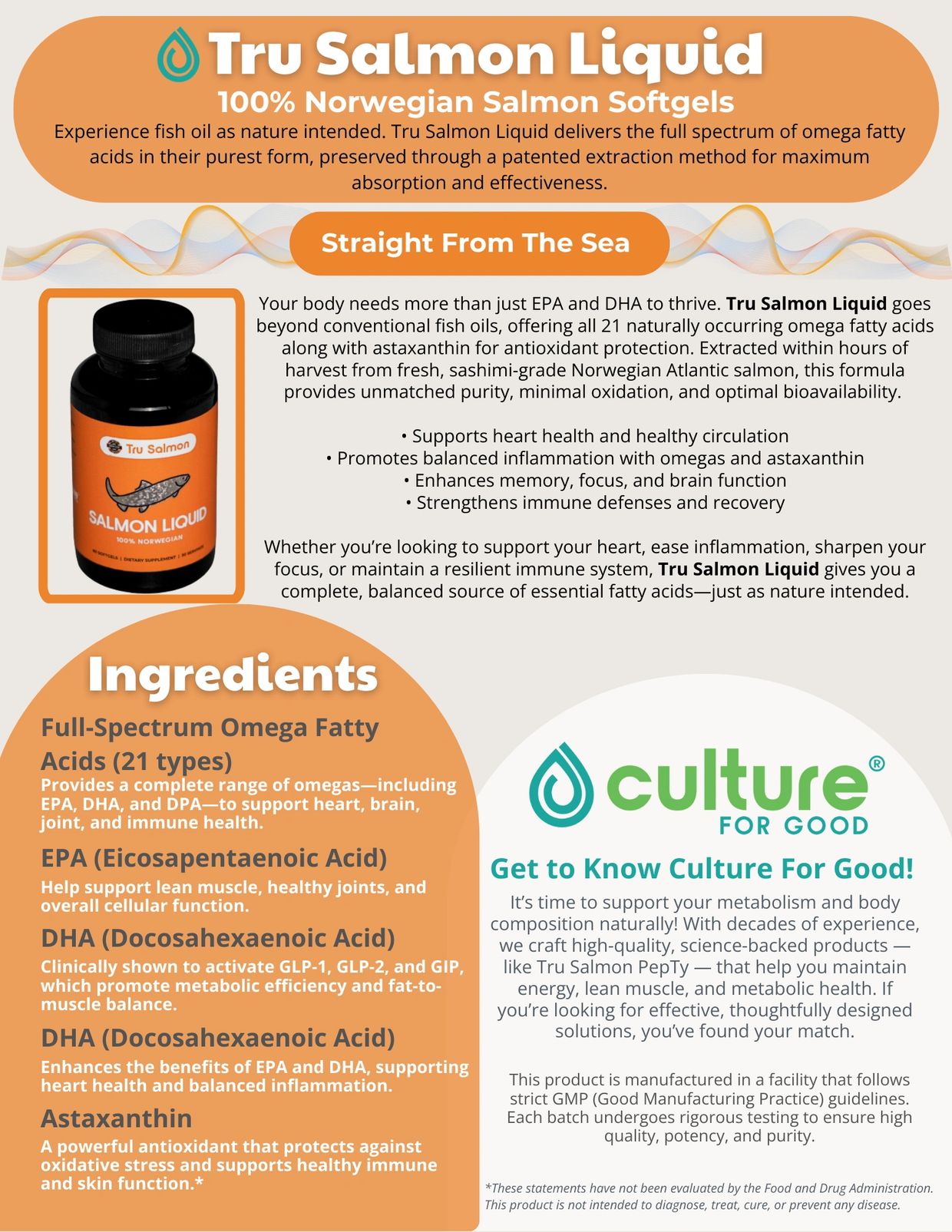
Why We Included Salmon Liquid Gel Caps
Your brain and nervous system depend heavily on healthy fats.
Omega fatty acids are structural components of cell membranes and play important roles in normal brain function, cellular communication, and the biological processes involved in how we think, feel, and respond.
Culture For Good’s Salmon Liquid Gel Caps provide a full spectrum of 21 naturally occurring omega fatty acids, including EPA and DHA, along with naturally occurring astaxanthin.
What makes the product particularly interesting is that it isn’t built around isolating only EPA and DHA.
The goal is to preserve a much broader spectrum of the naturally occurring fatty acids found in fresh Norwegian salmon.
That makes Salmon Liquid different from the products we’ve introduced so far.
This isn’t primarily about creating a particular state in the moment.
It’s about supporting the biological foundation through which your brain, nervous system, emotional state, and everyday capabilities are being expressed.
And that brings us right back to the principle underneath this entire conversation:
Support the receiver before you ask more from it.

Why We Included Blue Lotus
Sometimes greater access doesn’t come from doing more.
It comes from creating enough internal space to settle.
Blue Lotus has a long history of traditional use around relaxation, calm, and contemplative states, which makes it an interesting fit for people already exploring meditation, alignment, emotional state, and intentional practice.
Its role here is different from Salmon Liquid or Whole Flower Hemp.
This is about supporting the conditions around calm, balance, and a quieter internal state — especially when stress, stimulation, or mental activity are making those states harder to access.
Because sometimes the most useful thing you can do isn’t push harder toward the state you want.
It’s create better conditions for that state to become available.
Support the receiver. Then practice the state.
Why We Included Lion’s Mane
Lion’s Mane has become one of the most widely studied functional mushrooms for cognitive support.
What caught our attention is that some human research suggests its benefits may be more relevant with consistent use over time rather than from a single serving.
In one double-blind, placebo-controlled study, participants using Lion’s Mane for 16 weeks showed improvements in cognitive scores compared with placebo.
It’s important to keep that finding in context.
The participants in that study were older adults experiencing mild cognitive impairment, so it would be inappropriate to assume the same results for everyone.
But what interested us was the larger idea:
Lion’s Mane isn’t really an “I need my brain to work better in the next 20 minutes” kind of product.
It makes more sense as something used consistently to support the biological conditions associated with cognitive function over time.
And that fits beautifully with the larger philosophy of the Human Capability Project:
Support the conditions before you need the capability.
We’ve been exploring attention.
Memory.
Pattern recognition.
Creativity.
Problem-solving.
Intuition.
Adaptability.
And the many other capabilities through which you experience and navigate your life.
If those capabilities are being expressed through your biology, then supporting that biology consistently becomes part of the larger conversation about access.
That is why Lion’s Mane earned a place in this exploration.
And Lion’s Mane Is Only One Example
Culture For Good offers a much broader collection of whole-food functional nutrition and plant-based products designed to support the biological system from multiple directions.
Hops Drops — Vagus Nerve + Gut-Brain Support
Supports gut-brain signaling and digestive communication pathways while promoting calm, appetite balance, and digestive rhythm.
Beet Root Drops
Designed for rapid absorption and quick nutrient availability. Supports healthy circulation and exercise endurance and may help maintain healthy blood pressure levels already within the normal range.
Soursop Drops
Rich in powerful phytonutrients that support healthy cellular defense, strong immune function, and healthy oxidative balance.
Parasite Drops
Supports healthy digestion, helps soothe digestive discomfort, and contains natural ingredients and proprietary extracts known for their detoxifying properties.
Escalate
Provides nutrients that support focus during work, school, or physical activity.
Proteo
Plant-based proteolytic enzymes.
Biome Balance
A poteny probiotic and prebiotic supplement featuring spore-based probiotics designed to travel deeper into the gut.
Why Does the Breadth of This Line Matter?
Because we’re not looking at any one biological system in isolation.
Digestion.
The gut-brain connection.
Focus.
Circulation.
Exercise endurance.
Microbial balance.
Cellular defense.
Systemic enzyme support.
They are different aspects of the biological environment through which you experience your life and access your capabilities.
That is why we see Culture For Good as much more than a collection of individual supplements.
It is a broad nutritional toolkit for supporting the biological receiver.
The point isn’t that everyone needs every product.
It’s the larger principle we’ve been developing throughout this page:
Support the receiver because the receiver is the vehicle through which more consistent access to who you already are becomes possible.
You Are Always Rehearsing Your Emotions — By Design or By Default.
We’ve already established that your emotional state can influence what becomes more — or less — available to you.
Your focus.
Your creativity.
Your intuition.
Your ability to recognize possibilities.
Your ability to respond thoughtfully rather than react automatically.
Your ability to feel connected, appreciative, confident or calm.
So what if we stopped thinking about emotional states as something we simply experience in response to life?
What if we began treating them as something we can intentionally practice?
That idea became the foundation for what I call:
Intentional Emotional Rehearsal.
Most of us already understand rehearsal.
An athlete rehearses a movement.
A musician rehearses a piece of music.
An actor rehearses a performance.
A speaker rehearses a presentation.
We rehearse because repetition helps make something more familiar, more available and easier to access when we need it.
But we are also rehearsing emotional states.
Every time we repeatedly experience frustration, worry, resentment, appreciation, confidence, love, abundance, calm or joy, we are giving our system another experience of that state.
You are always rehearsing your emotions — by design or by default.
And that raises an interesting possibility.
Instead of waiting for the outside world to give you a reason to feel the way you want to feel…
What if you intentionally practiced accessing those emotions first?
Appreciation.
Love.
Abundance.
Joy.
Confidence.
Calm.
Focus.
Emotional stability.
Not because experiencing those states guarantees that a particular outcome will appear.
But because the state you are operating from can influence what you notice.
What you expect.
What possibilities you recognize.
How you communicate.
How you respond.
What actions feel available.
And how other people experience you.
For someone already familiar with Law of Attraction, this may sound very familiar.
The difference is where we place the emphasis.
The goal isn’t simply to create an elevated emotional state for a few minutes during meditation or visualization.
The deeper opportunity is to help certain emotional states become more familiar, more accessible and easier to return to when life gives you a reason to move away from them.
That is conditioning.
And just as repetition can influence the brain through neuroplasticity and implicit learning,
repeated emotional experience can become part of what your system becomes increasingly familiar with.
You’re not trying to become someone else.
You’re practicing greater access to states and capabilities that are already available within you.
And that brings us to the practical application of Intentional Emotional Rehearsal:
The Morning Reset.
Experience It.
Understanding Intentional Emotional Rehearsal is one thing.
Experiencing it is another.
So before we go any further, I’d like to give you an opportunity to experience the vibe of the actual 15-minute daily Morning Reset practice for yourself.
The audio below is a short sample drawn from the opening and closing portions of the full practice.
It does not include the approximately ten minutes of Intentional Emotional Rehearsal contained in the complete Morning Reset.
The soundtrack you’re hearing isn’t simply relaxing background music.
From beginning to end, the entire Morning Reset soundtrack was deliberately designed and sequenced using sounds intended to support Alpha, Theta, Delta, and Gamma brainwave activity at specific moments throughout the practice.
This sample gives you an opportunity to step out of everything else for a few minutes and experience the sound, pacing, and overall feel of the process.
If possible, use earbuds or headphones so you can experience the carefully layered sounds as they were designed to be heard.
Get comfortable.
Close your eyes if that feels natural.
And for the next few minutes, don’t worry about trying to accomplish anything.
Just experience it.
When it ends, take a moment and notice what changed.
Your breathing.
Your body.
Your thoughts.
Your emotional state
.
Your attention.
Maybe the shift is significant.
Maybe it’s subtle.
There is no particular experience you are supposed to have.
The point is simply to experience for yourself something we’ve been exploring throughout this page:
Your internal state can change.
And with intentional practice, certain states can become more familiar, more accessible and easier to return to.
Now experience it for yourself.
What Others Have Experienced

The Morning Reset
If what you’ve explored on this page resonates with you, the Morning Reset is an opportunity to turn Intentional Emotional Rehearsal into a simple daily practice.
It is a 15-minute guided experience designed to help you intentionally access and rehearse emotional states you may want to become more familiar with.
Love.
Appreciation.
Abundance.
Joy.
Emotional stability.
Calm.
Confidence.
Focus.
Every part of the Morning Reset soundtrack was deliberately designed and sequenced using sounds intended to support Alpha, Theta, Delta, and Gamma brainwave activity at specific moments throughout the practice.
The words guide what you rehearse.
The sound helps create the receptive internal conditions in which the entire experience takes place.
The goal is not to tell you what you should feel.
And it is not about replacing meditation, visualization, appreciation, prayer, journaling, yoga or any other practice that already supports you.
It is simply another tool.
A structured opportunity to repeatedly give your system experience with emotional states you may want greater access to—not only during the practice itself, but when life gives you a reason to move away from them.
Because the real opportunity is not simply being able to create a state for a few minutes.
It is helping that state become more familiar, more accessible and easier to return to.
What You Receive
The complete 15-Minute Morning Reset daily practice.
A 5-Minute Quick Reset for times when you want a shorter experience.
The Morning Reset Baseline Reflection—an opportunity to capture where you are when you begin.
The Morning Reset Progress Journal—a simple way to notice and document changes over time.
Lifetime access to the practice and resources.
A 30-day money-back guarantee.
Together, these pieces make Morning Reset more than a daily practice.
They create a personal development system designed to help you practice intentionally, observe what’s happening in your life, track what changes over time, and develop more consistent access to the states and capabilities you want available.
The Morning Reset is available for a one-time investment of $88.
No subscription.
No recurring fees.
Just a simple daily practice—along with resources designed to help you become more aware of what may be changing as you use it.
You Already Possess the Capabilities.
The Human Capability Project is built around a simple distinction:
You do not need to become someone fundamentally different.
You already possess remarkable innate capabilities.
The opportunity is to create conditions that support more consistent access to them.
Supporting your biology is one part of that.
Intentionally rehearsing your emotional state is another.
The Morning Reset was created to support that practice.
If you’d like to experience what can happen when you begin rehearsing your emotional state by design rather than by default, you’re invited to begin.